Solutions · cooperative banking networks

The orchestration platform for federated cooperative banking.

One runtime. N tenants. Per-bank bindings. Cooperative and mutual banking networks share a shape no tier-1 vendor was built for: federated governance, modest per-bank IT budgets, the regulatory burden of a tier-1, and a fierce attachment to local autonomy. Klyqo is the composable orchestration layer that fits.

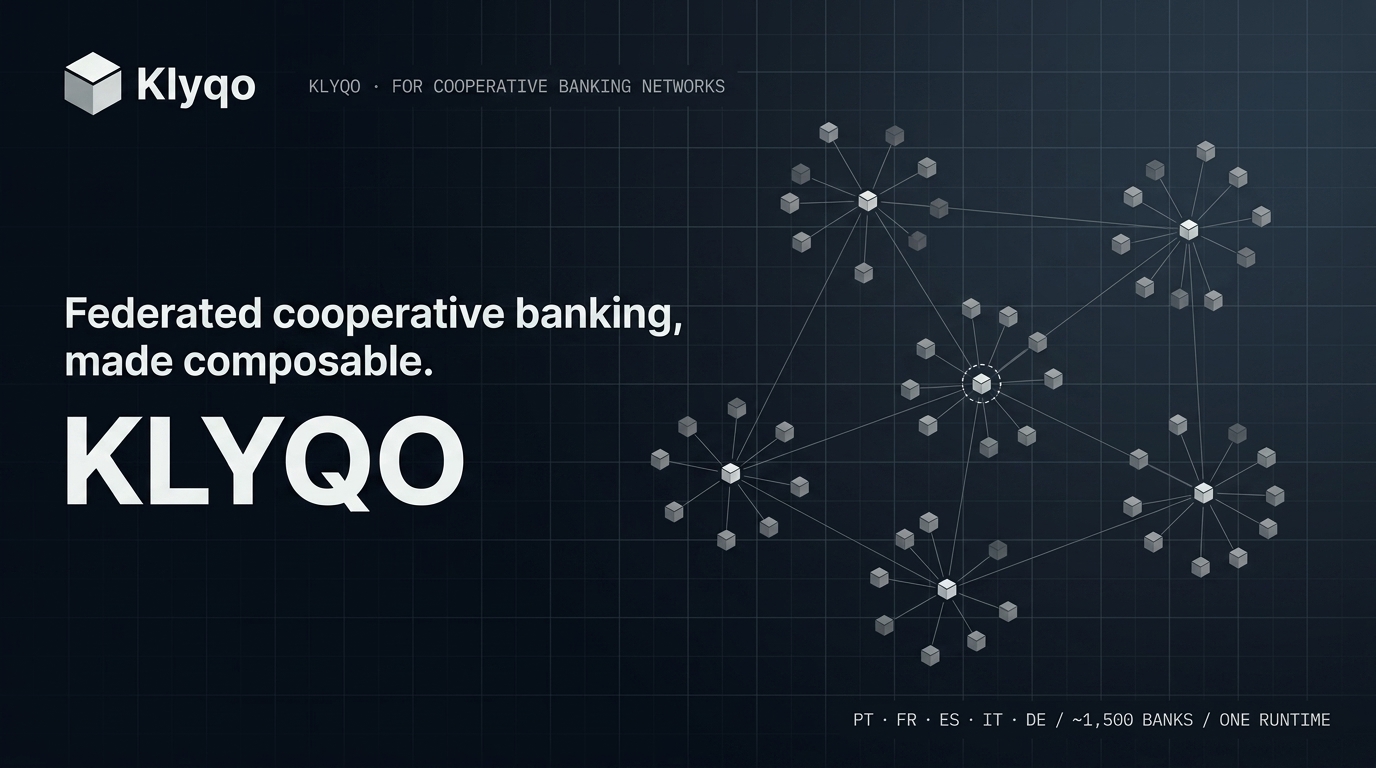
Federated cooperative banking, made composable. A constellation of small geometric nodes clustered into five federations (Portugal, France, Spain, Italy, Germany), connected through a central runtime.
Architecture One platform · N tenants
Per-bank scope Bindings, not rebuilds
Time to live Months, not years
Lock-in Swap any provider
The federation map
Portugal
~80
Caixas Agrícolas across Crédito Agrícola and the independent Agrimutuo network.
France
39
Regional caisses of Crédit Agricole, each with local governance.
Spain
~100
Cajas rurales and cooperative-bank federations across the regions.
Italy
~200
Mutual cooperative banks across the federated networks.
Germany
~700
Volksbanken and Raiffeisenbanken under the BVR umbrella.

~1,500 cooperative & mutual banks across the EU · same governance shape · same modernization gap

Why the existing market doesn’t fit

Three reasons cooperative banks get stuck.

The platforms pitched to a Crédito Agrícola or a Volksbank were designed for tier-1 commercial banks. The fit is consistently wrong, in three predictable ways.

01 · Budget mismatch

Temenos and Backbase price for $50M IT budgets.

A municipal cooperative has €300k to €1.5M for the entire modernization. Tier-1 vendor sales motions, implementation timelines, and licensing structures don’t work at this scale. The proposal arrives at €1.45M and 18 months for a build that the bank operates on for fifteen years.

02 · Federation blindness

Group infrastructure varies; vendors assume it doesn’t.

Some federations (Crédito Agrícola group) share back-office, reporting, bancassurance through a central institution. Others (Agrimutuo) don’t. One-size proposals from horizontal vendors either over-build what the group already provides or under-build what the bank actually needs.

03 · Per-bank rebuilds

Each bank reimplements the same journey from scratch.

Eighty Caixas Agrícolas, eighty separate vendor contracts, eighty separate consumer onboarding builds, eighty separate compliance integrations. Nothing in the existing market treats a federated network as a single deployment target. Every modernization is the first modernization.

How Klyqo fits

A platform that treats the network as the deployment, not the bank.

Klyqo’s runtime was built for the shape cooperative networks actually have: multi-tenant by default, federation-aware, per-bank bindings, group-level visibility. The work each bank pays for compounds into the network the group runs.

  1. One runtime, N tenants. Same code, different bindings.

    Each member bank is a Klyqo tenant. Tenant A binds KYC to Onfido and ledger to Mambu; Tenant B binds KYC to IDnow and ledger to the group’s shared instance. Same journey definitions, different providers per tenant. Postgres row-level security isolates everything by tenant from the database up.

    Multi-tenant Per-tenant RLS One codebase
  2. Journeys as policy-as-code. Auditable by default.

    Every customer-facing flow — account opening, lending, transfers, KYC refresh — is a TypeScript journey definition. Every step is signed, append-only, regulator-replayable. Banco de Portugal, BaFin, FinCEN, Banca d’Italia all ask for the same artifact. Klyqo produces it without an export pipeline.

    Policy-as-code Signed audit log Regulator export
  3. Federation-level governance. Network reports, not just bank reports.

    A group sees aggregate posture across all member banks — AML alerts, regulatory metrics, provider SLAs — without breaking tenant isolation. Each member bank sees only its own data. The network operator gets the consolidated view the existing market doesn’t produce.

    Network dashboards Aggregate reporting Tenant isolation
  4. Vertical templates the existing market doesn’t ship.

    Agricultural lending. Cooperative member onboarding and share capital subscription. AGM workflows. IFAP subsidy reconciliation. The journey blueprints unique to mutual and cooperative banking, packaged and ready to bind to your providers. No tier-1 vendor will build these; we already have.

    Agri lending Member services IFAP
  5. Operator Copilot. AI that helps your branch staff, not replaces them.

    Klyqo’s signed audit log is the substrate for a regulator-friendly operator assistant. Help a branch advisor triage twenty KYC exceptions, draft a customer email about a declined transaction, pre-fill a Banco de Portugal query, summarize a loan file. Human approves every action. No autonomous customer-facing agents.

    Operator-side AI Human-in-the-loop Audit-grounded
Pre-built journey templates

The work no horizontal vendor has done.

Cooperative banking has its own product catalogue. Klyqo ships journey templates for the ones that matter, ready to bind to your providers and adapt to your federation.

Lending · agricultural

IFAP-aligned crop and livestock loans.

Farmer registration with IFAP eligibility check, parcel data capture, harvest-aligned amortization schedules, CAP subsidy reconciliation into the loan. Designed around how Portuguese, Spanish and Italian cooperatives already lend.

Lending · consumer

Microcredit and small consumer loans.

Income verification, credit scoring through your bound engine, eIDAS-signed contracts, disbursement to a Mambu current account. Fifteen-minute application path for the local-market consumer who already banks with you.

Onboarding · member

Cooperative member admission.

KYC with Cartão de Cidadão or local eID, AML screening, board-approval workflow, share-capital subscription, member-services provisioning. The flow no horizontal challenger has bothered to build.

Member services

Share capital and capital movements.

Subscription, certificate issuance, dividend distribution, capital withdrawal under cooperative statutes. Per-bank rules, group-level reporting, audit trail every step.

Governance

AGM and member participation.

Convocation, agenda distribution, identity-bound remote attendance, e-voting per resolution with audit-grade traceability. Designed to satisfy cooperative statutes and EU governance regulation simultaneously.

Compliance

PSD2/PSD3 consent management.

Per-customer consent capture, scope management, revocation, audit log, regulator-export bundling. A capability nobody in your category provides; a regulatory line item that doesn’t care that you’re a small bank.

Reference architecture · Mambu on AWS

What this architecture has done elsewhere: 50M EUR loan portfolio in 18 months.

A reference point, not a customer. AWS published a case study on Raiffeisen Digital Bank in Romania: Mambu on AWS, loan decisions in 15 minutes, disbursement under 30 minutes, full digital deployment from greenfield. The architecture pattern is the same one Klyqo builds toward for federated cooperative networks. Klyqo is in design-partner phase; first public Klyqo case studies are gated on launch partners being ready to be named.

Public AWS reference · Raiffeisen Digital Bank, 2024 · not a Klyqo customer

50M EUR
Loan portfolio
18 months
Greenfield to scale
15 minutes
Loan decision time
<30 min
Disbursement to account
Reference architecture

Start from the Cooperative Banking Blueprint.

A pre-packaged set of journey templates, recommended provider bindings, and federation-aware configuration. Clone the repo, bind to your providers, deploy. The work compounds: every adapter you wire becomes a template the next bank in your network reuses.

Blueprint · Cooperative Banking

Member onboarding, agricultural lending, payments and audit, in one repo.

TypeScript journey definitions for the workflows that define a cooperative bank, with Mambu adapter bindings, eIDAS contract signing via Multicert, SEPA Instant payments through TIPS, Cartão de Cidadão identity, and the signed audit log spanning every step. Default mock adapters let your team run locally before binding to live providers.

See blueprints

Modernize without the tier-1 build.

Talk to us about your cooperative network. Thirty minutes, no deck. We’ll walk through the runtime, the cooperative blueprint, and tell you honestly which member bank should go first.